
Getting to Know… Professor Dorian Hargrave
An interview, written by Taran O’Mordha
School: Beauxbaton
Favorite Colour: Blue
Favorite Sweets: Baklava
Favourite Food: Moussaka
Favourite Drink: Visanada, starts to like Butterbeer
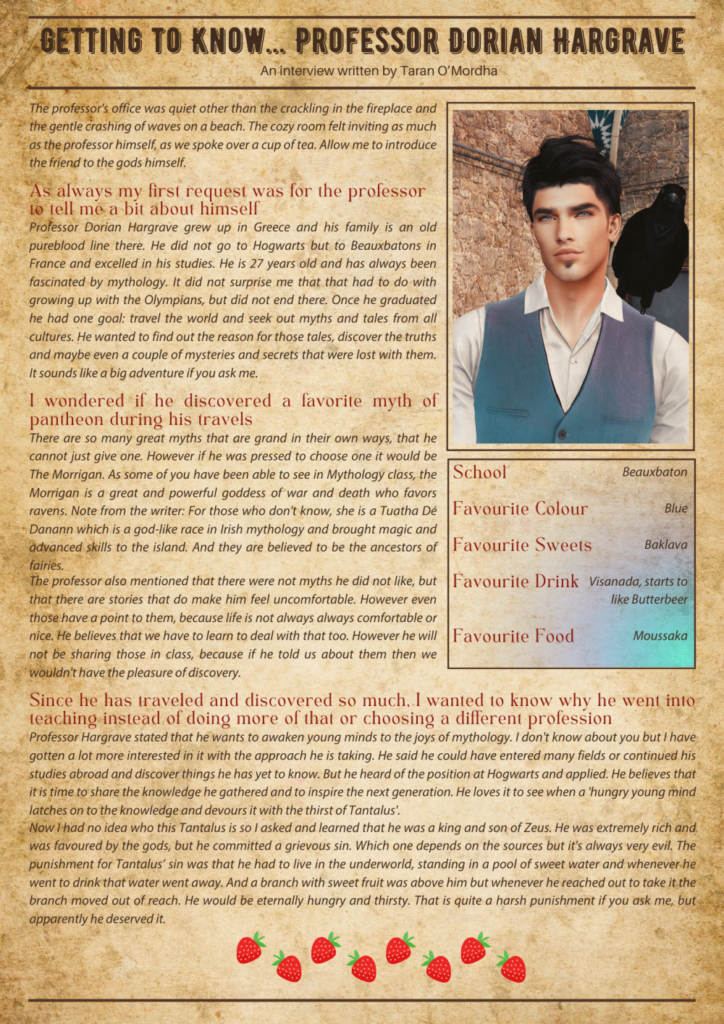
The professor’s office was quiet other than the crackling in the fireplace and the gentle crashing of waves on a beach. The cozy room felt inviting as much as the professor himself, as we spoke over a cup of tea. Allow me to introduce the friend to the gods himself.
As always my first request was for the professor to tell me a bit about himself
Professor Dorian Hargrave grew up in Greece and his family is an old pureblood line there. He did not go to Hogwarts but to Beauxbatons in France and excelled in his studies. He is 27 years old and has always been fascinated by mythology. It did not surprise me that that had to do with growing up with the Olympians, but did not end there. Once he graduated he had one goal: travel the world and seek out myths and tales from all cultures. He wanted to find out the reason for those tales, discover the truths and maybe even a couple of mysteries and secrets that were lost with them. It sounds like a big adventure if you ask me.
I wondered if he discovered a favorite myth of pantheon during his travels
There are so many great myths that are grand in their own ways, that he cannot just give one. However if he was pressed to choose one it would be The Morrigan. As some of you have been able to see in Mythology class, the Morrigan is a great and powerful goddess of war and death who favors ravens. Note from the writer: For those who don’t know, she is a Tuatha Dé Danann which is a god-like race in Irish mythology and brought magic and advanced skills to the island. And they are believed to be the ancestors of fairies.
The professor also mentioned that there were not myths he did not like, but that there are stories that do make him feel uncomfortable. However even those have a point to them, because life is not always always comfortable or nice. He believes that we have to learn to deal with that too. However he will not be sharing those in class, because if he told us about them then we wouldn’t have the pleasure of discovery.
Since he has traveled and discovered so much, I wanted to know why he went into teaching instead of doing more of that or choosing a different profession
Professor Hargrave stated that he wants to awaken young minds to the joys of mythology. I don’t know about you but I have gotten a lot more interested in it with the approach he is taking. He said he could have entered many fields or continued his studies abroad and discover things he has yet to know. But he heard of the position at Hogwarts and applied. He believes that it is time to share the knowledge he gathered and to inspire the next generation. He loves it to see when a ‘hungry young mind latches on to the knowledge and devours it with the thirst of Tantalus’.
Now I had no idea who this Tantalus is so I asked and learned that he was a king and son of Zeus. He was extremely rich and was favoured by the gods, but he committed a grievous sin. Which one depends on the sources but it’s always very evil. The punishment for Tantalus’ sin was that he had to live in the underworld, standing in a pool of sweet water and whenever he went to drink that water went away. And a branch with sweet fruit was above him but whenever he reached out to take it the branch moved out of reach. He would be eternally hungry and thirsty. That is quite a harsh punishment if you ask me, but apparently he deserved it.
I was wondering what other subject he would teach if he wasn’t teaching Mythology
Since Mythology is his passion that was a really difficult question, but he did have a few ideas. One was Astronomy because constellations are connected to Mythology. Another was Ancient Studies because of the same link. History also goes in hand with Mythology so this would be another option.
Since I asked Professor Helkirk before I wanted to hear Professor Hargrave’s opinion to the question, what he believes the difference between Mythology and History is
For him the main difference is that one of them is fact based and the other is possible fact. He brought in an example in ‘Troy’. We know it existed, but there are some stories that may be pure legend such as the story of the untouchable warrior who was killed by an arrow to his ankle just because his mother held him by it while washing him in the River Styx. For those who are not familiar, it’s the story of Achilles, no judgement here I had to look it up too.
To Professor Hargrave Mythology is stories that teach us lessons through narration. So it uses plot devices, fiction, ideas of deities, heroes, villains and supernatural creatures to explain how the world works or tell us what we should or should not do. They tell us a moral. Some stories still hold some truth but we have to find out what that truth is. Some stories have more truth than others.
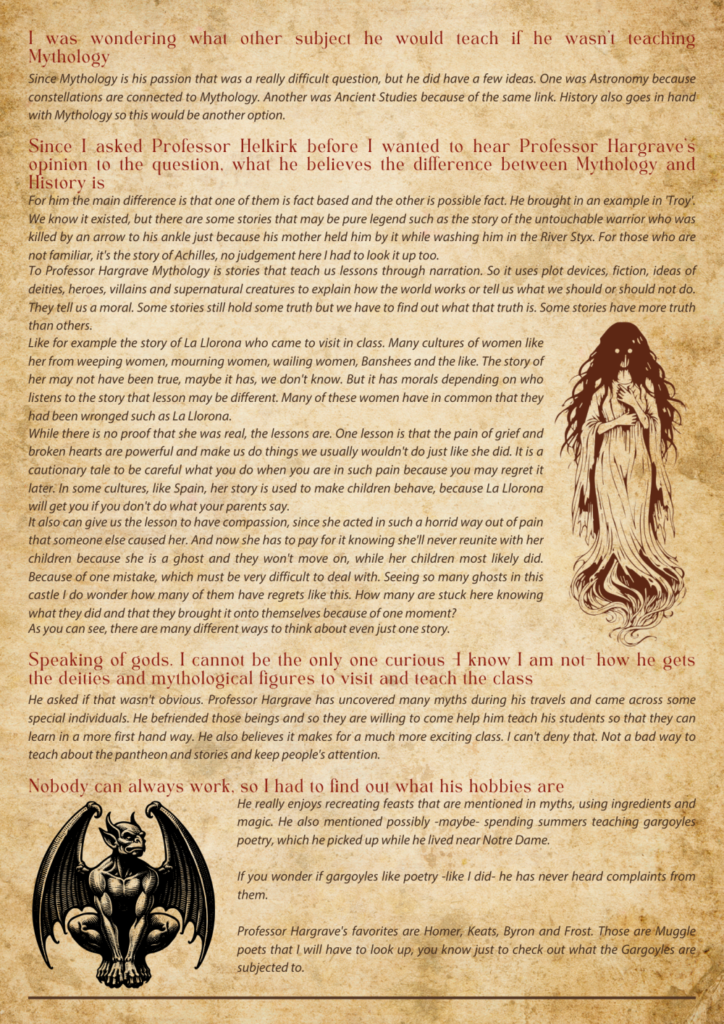
Like for example the story of La Llorona who came to visit in class. Many cultures of women like her from weeping women, mourning women, wailing women, Banshees and the like. The story of her may not have been true, maybe it has, we don’t know. But it has morals depending on who listens to the story that lesson may be different. Many of these women have in common that they had been wronged such as La Llorona.
While there is no proof that she was real, the lessons are. One lesson is that the pain of grief and broken hearts are powerful and make us do things we usually wouldn’t do just like she did. It is a cautionary tale to be careful what you do when you are in such pain because you may regret it later. In some cultures, like Spain, her story is used to make children behave, because La Llorona will get you if you don’t do what your parents say.
It also can give us the lesson to have compassion, since she acted in such a horrid way out of pain that someone else caused her. And now she has to pay for it knowing she’ll never reunite with her children because she is a ghost and they won’t move on, while her children most likely did. Because of one mistake, which must be very difficult to deal with. Seeing so many ghosts in this castle I do wonder how many of them have regrets like this. How many are stuck here knowing what they did and that they brought it onto themselves because of one moment?
As you can see, there are many different ways to think about even just one story.
Speaking of gods. I cannot be the only one curious -I know I am not- how he gets the deities and mythological figures to visit and teach the class
He asked if that wasn’t obvious. Professor Hargrave has uncovered many myths during his travels and came across some special individuals. He befriended those beings and so they are willing to come help him teach his students so that they can learn in a more first hand way. He also believes it makes for a much more exciting class. I can’t deny that. Not a bad way to teach about the pantheon and stories and keep people’s attention.
Nobody can always work, so I had to find out what his hobbies are
He really enjoys recreating feasts that are mentioned in myths, using ingredients and magic. He also mentioned possibly -maybe- spending summers teaching gargoyles poetry, which he picked up while he lived near Notre Dame.
If you wonder if gargoyles like poetry -like I did- he has never heard complaints from them.
Professor Hargrave’s favorites are Homer, Keats, Byron and Frost. Those are Muggle poets that I will have to look up, you know just to check out what the Gargoyles are subjected to.
The Professor mentioned that he studied in Beauxbaton and I needed to know what the differences are between the schools
You know other than that it is in France and that they most likely speak French there. Other than Tri-Wizard Tournaments we don’t really get to see much of them, right? Professor Hargrave shared that Beauxbaton does not have Houses like we do and they do not have ghosts! Can you imagine that? No ghosts? I can’t, there are so many here. He said he had run into ghosts during his travels, but he is still getting used to the amount of them at Hogwarts. But instead of ghosts Beauxbaton has wood nymphs, which sounds grand. Their food tends to be lighter and more elegant than ours. The school is not a castle but a chateau. But the biggest difference at least for someone who is only a year and a half away from their O.W.L.s is that they have that exam in their sixth year instead of the fifth. So they do the two big ones in subsequent years instead of having a year break in between. Some people may find that stressful but the students feel very prepared when it’s time. How is that for our seventh year students? Would you have wished to have one more year to prepare for O.W.L.s?
Naturally I asked Professor Hargrave for his favorites!
His favourite color is blue. He thinks that is really lucky because he had to wear it for seven years.
His favorite drink is visanada, but he is becoming fond of butterbeer. Visanada is a refreshing drink made from the syrup of sour cherries, with sugar and water.
His favourite sweet is baklava and his favorite food is moussaka.
These foods and the drink are from his homeland Greece. They bring memories back for him of family meals with the family, sitting around a table, enjoying the food and drinks while they sing and tell stories. If you are used to quiet mealtimes like me, this is very different. A lot of talking, toasting, singing and telling stories is happening while they eat. It seems important to the Greek that nobody leaves hungry or unhappy, because they are all about hospitality which is something they learned from their gods.
As always I asked if Professor Hargrave has some wise words or piece of advice to share with all of us
To keep this as much as possible in the spirit of what he wants to say I’ll directly quote this instead of paraphrasing.
“I have a few. Firstly, Prometheus stole fire for mankind, may you always burn, not to destroy, but to illuminate.
Secondly, the gods do not favour the perfect, they favour the curious.
And lastly, remember, even monsters were heroes in their own stories.”