
An interview written by Taran O’Mordha
The Mythology classroom always has a hint of mystery to it, no surprise with the subject taught in it. When I entered it this time the mystery felt more palpable with the distant sound of ritualistic drums accompanying the interview like gentle background music. Meeting the Professor I was curious to find out more about the man who’s bringing these myths to us. Join me on that adventure.
I asked the Professor to tell us a bit about himself
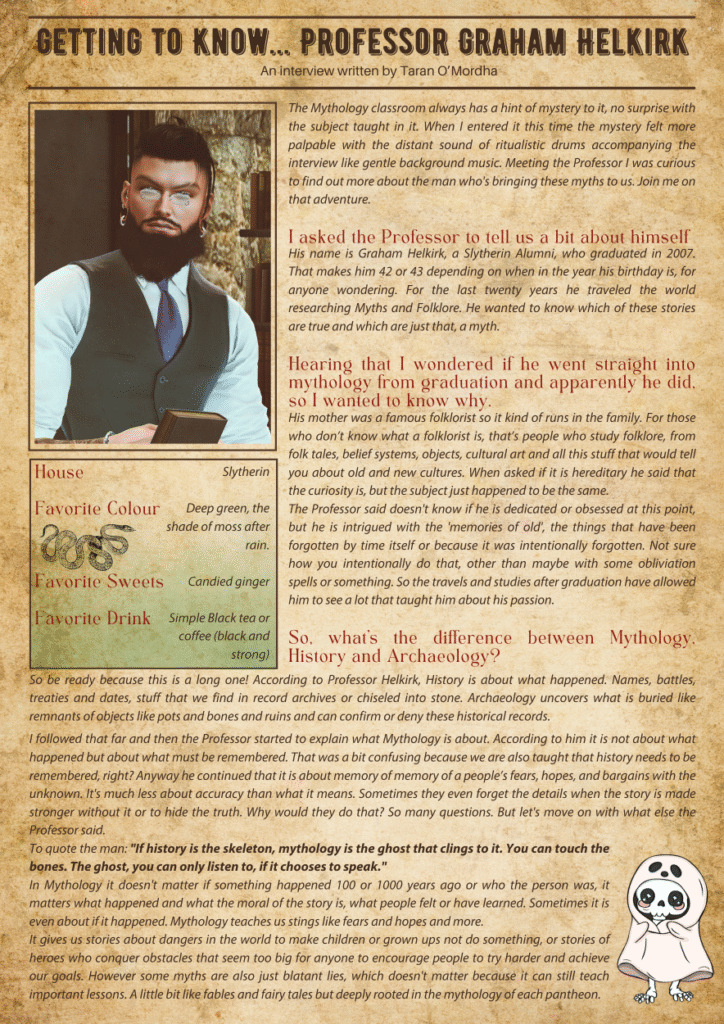
His name is Graham Helkirk, a Slytherin Alumni, who graduated in 2007. That makes him 42 or 43 depending on when in the year his birthday is, for anyone wondering. For the last twenty years he traveled the world researching Myths and Folklore. He wanted to know which of these stories are true and which are just that, a myth.
Hearing that I wondered if he went straight into mythology from graduation and apparently he did, so I wanted to know why.
His mother was a famous folklorist so it kind of runs in the family. For those who don’t know what a folklorist is, that’s people who study folklore, from folk tales, belief systems, objects, cultural art and all this stuff that would tell you about old and new cultures. When asked if it is hereditary he said that the curiosity is, but the subject just happened to be the same.
The Professor said doesn’t know if he is dedicated or obsessed at this point, but he is intrigued with the ‘memories of old’, the things that have been forgotten by time itself or because it was intentionally forgotten. Not sure how you intentionally do that, other than maybe with some obliviation spells or something. So the travels and studies after graduation have allowed him to see a lot that taught him about his passion.
So, what’s the difference between Mythology, History and Archaeology?
So be ready because this is a long one! According to Professor Helkirk, History is about what happened. Names, battles, treaties and dates, stuff that we find in record archives or chiseled into stone. Archaeology uncovers what is buried like remnants of objects like pots and bones and ruins and can confirm or deny these historical records.
I followed that far and then the Professor started to explain what Mythology is about. According to him it is not about what happened but about what must be remembered. That was a bit confusing because we are also taught that history needs to be remembered, right? Anyway he continued that it is about memory of memory of a people’s fears, hopes, and bargains with the unknown. It’s much less about accuracy than what it means. Sometimes they even forget the details when the story is made stronger without it or to hide the truth. Why would they do that? So many questions. But let’s move on with what else the Professor said.
To quote the man: “If history is the skeleton, mythology is the ghost that clings to it. You can touch the bones. The ghost, you can only listen to, if it chooses to speak.”
In Mythology it doesn’t matter if something happened 100 or 1000 years ago or who the person was, it matters what happened and what the moral of the story is, what people felt or have learned. Sometimes it is even about if it happened. Mythology teaches us stings like fears and hopes and more.
It gives us stories about dangers in the world to make children or grown ups not do something, or stories of heroes who conquer obstacles that seem too big for anyone to encourage people to try harder and achieve our goals. However some myths are also just blatant lies, which doesn’t matter because it can still teach important lessons. A little bit like fables and fairy tales but deeply rooted in the mythology of each pantheon.
Does he have a favorite branch of Mythology, a location or people involved? Or even a favorite myth overall?
Surprisingly he doesn’t, but not because he doesn’t like any enough. No he has a whole other reason. He avoids that word because he believes that favouring a myth would claim that it is harmless, but none of them are.
He does have stories he returns to more often than others. For example the Norse Myth of Ginnungagap, the yawning void before creation —a silence so vast it could devour gods. His words not mine. He told me that he was in Iceland standing on grounds that the locals still speak of as that particular emptiness as if it was a neighbour. Professor Helkirk also mentioned that he was in West Africa and listened to someone reciting tales of Anansi, a trickster spider. He said he spun the web across every sentence, teaching that laughter itself can be a weapon against fear. These kinds of tales linger with the Professor.
And then there are stories he can’t mention because he believes speaking freely about them will invite them in. In a way they are his favorites because they refuse to let him go.
Why does talking about something bring it back? That sounds like a house ghost that comes when mentioning their name.
Professor Helkirk confirmed that I’m not wrong with my comparison. He believes that words have weight and when you repeat words they are invitations. He compared that with learning spells, words and intent. Every time a culture tells a myth it breathes more life into it, the story sharpens, feeds and becomes harder to forget. That’s what you want to achieve with a story like that after all, yeah?
He asked that if no one at Hogwarts ever spoke of the Bloody Baron again, how long before he ceased to rattle chains? A century? Two? Memory is sustenance. Now I don’t think that is how ghosts work, he can still remind us that he is there, since he is. But I think I get what he means.
There are myths that are sleeping until someone mentions them again, others are always around and restless, waiting for someone careless enough to give them a way to return. So according to the professor. So “that is why we must listen carefully, and speak sparingly. Not because the story will leap off the page like a poltergeist, but because stories shape thought – and thought, in this world, shapes reality more than we care to admit.”
When he is not teaching or hunting down more mythology… what does he like to do? Any hobbies, passions or obsessions?
He said that all he does is researching or rewriting, hoping to one day publish a book of his findings. I hope he will get that, because he sounds like he’s really passionate about this field. He also says he enjoyed a game of Quidditch now and then, and an ale with friends.
I asked him what brought him to teaching instead of doing something else that involved mythology or focus on his book plans and travel.
He said age caught up with him and he needed a break, which makes sense, my parents are old too and need a lot of breaks. He also didn’t go into teaching to shape the future or wixen minds. He wants to teach because he wants us to listen, that is his purpose. He wants us to learn how to hear the pulse in a story like one would listen to the heartbeat of a dragon under earth. Did you know there are dragons down there? I didn’t. He thinks that if we have that skill we shape ourselves. He just wants to keep us from stepping on stories that bite.
Of course I also asked him about his favorites, so here we go!
His favourite colour is deep green, the shade of moss after rain. He said it endures and it smells of earth and memory.
When asked for his favorite sweets he asked if I realise that it’s easier for him to name the serpent that gnaws at the roots of the world than to declare a favorite sweet. I was confused because I didn’t know of a serpent at the roots of Crann Bethadh and wouldn’t you believe that is another world tree with a serpent called Nidhogg and we’ll learn about that later. But back to the question, he has a weakness for candied ginger. It’s sharp, sweet, and just enough to remind you you’re alive. Is he that old that he needs reminders?
His favourite drink is a simple black tea or coffee without sugar or milk or anything. He also likes it really strong, so strong that he can stand a spoon upright in it. No idea why he would want to do that but I won’t yuck his yum. He thinks that anything weaker is leaf-flavoured water.
One of the most important questions of the interview was of course how he had managed to get such a glorious beard! And when he started growing it.
He said he had a beard since he was about 15. Which is a good age, and I am not just saying that because I am almost 15. He uses a muggle invention called beard wax for the shape. Before he grew it out he had it braided to not be in the way. Apparently it was not super popular with the girls though. I can’t imagine why. So those of you who can grow beards, there you have it. Someone know where I can get some of that wax? Will candle wax do?
Last but not least I asked him for any advice, wise words, warnings and so on towards the students reading his interview.
And boy, he had plenty. So I am going to directly quote it for you.
“Advice? Very well. First, do not mistake noise for wisdom. The loudest voices are often the ones most eager to hide their ignorance. Listen more than you speak, and you will hear what others miss.
Second, take care with your promises. A careless vow can bind you more tightly than the strongest chain. Words are heavier than they look.
And finally, remember that stories are patient. They will wait for you in libraries, in the margins of books, in the whispers of portraits and ghosts. But life is not so patient. Do not spend all your years reading about the world when you might walk through it. The stories will still be here when you return.
If you must carry one warning away with you, let it be this: never laugh too easily at superstition. Behind every superstition lies something someone once feared enough to remember. And fear, like myth, does not die easily.”